States of Exception, States of Emergence
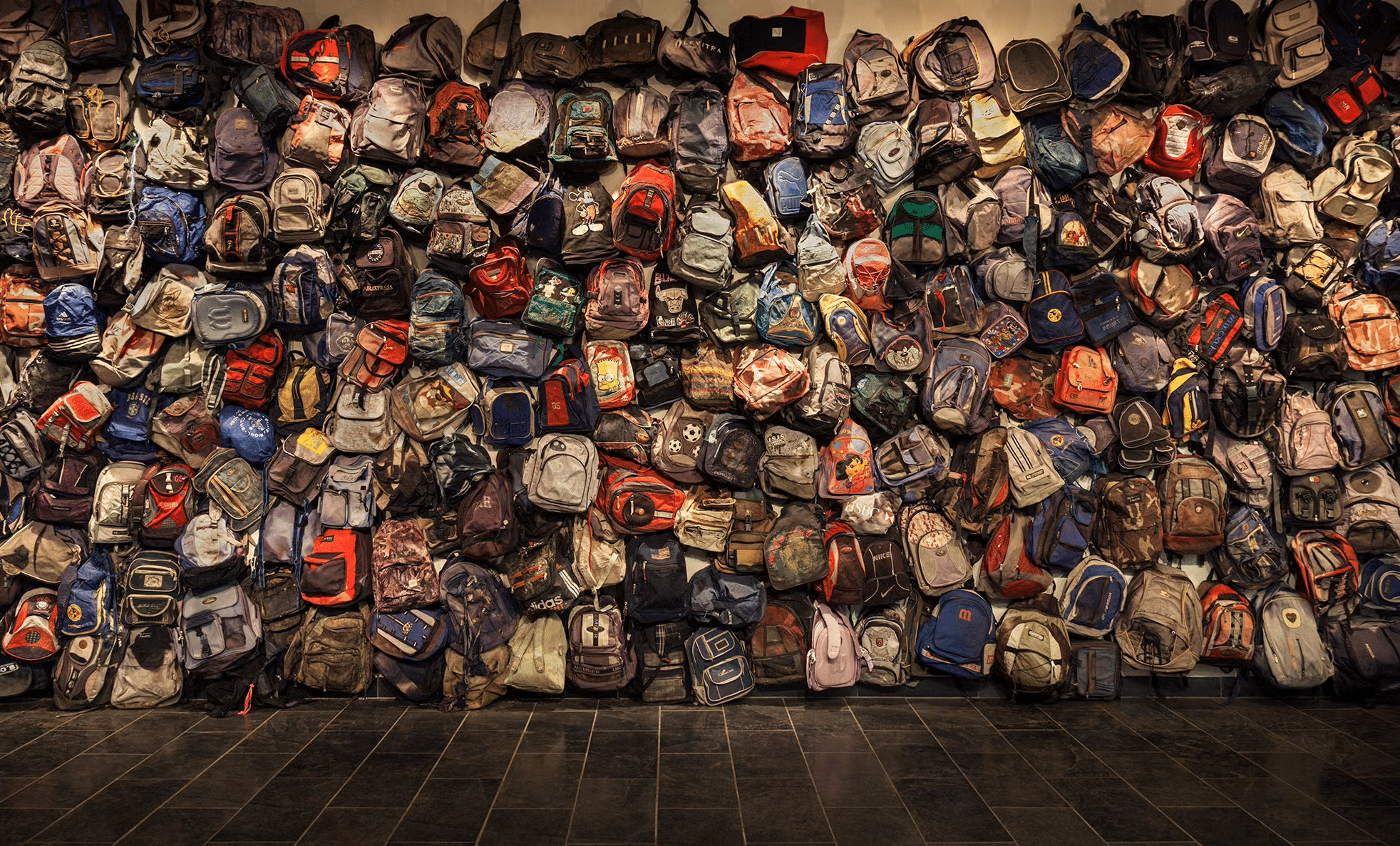
In 2017, anthropologist Jason de León collaborated with artist/curator Amanda Krugliak and photographer Richard Barnes to create a provocative installation entitled State of Exception/Estado de Excepción. As The New York Times observed in its review: “Strong political art is hard to make. So, when it turns up, it’s worth a look.” State/Estado collects battered backpacks, castoff clothes, dented water bottles, and other human debris that had been left in the Sonoran desert, a brutal stretch of southwestern borderland, by undocumented migrants as they crossed over into the US. The installation highlights, in the lethal limbo of the border, both the labile liminality of their legal status and the fragile materiality of their lives.
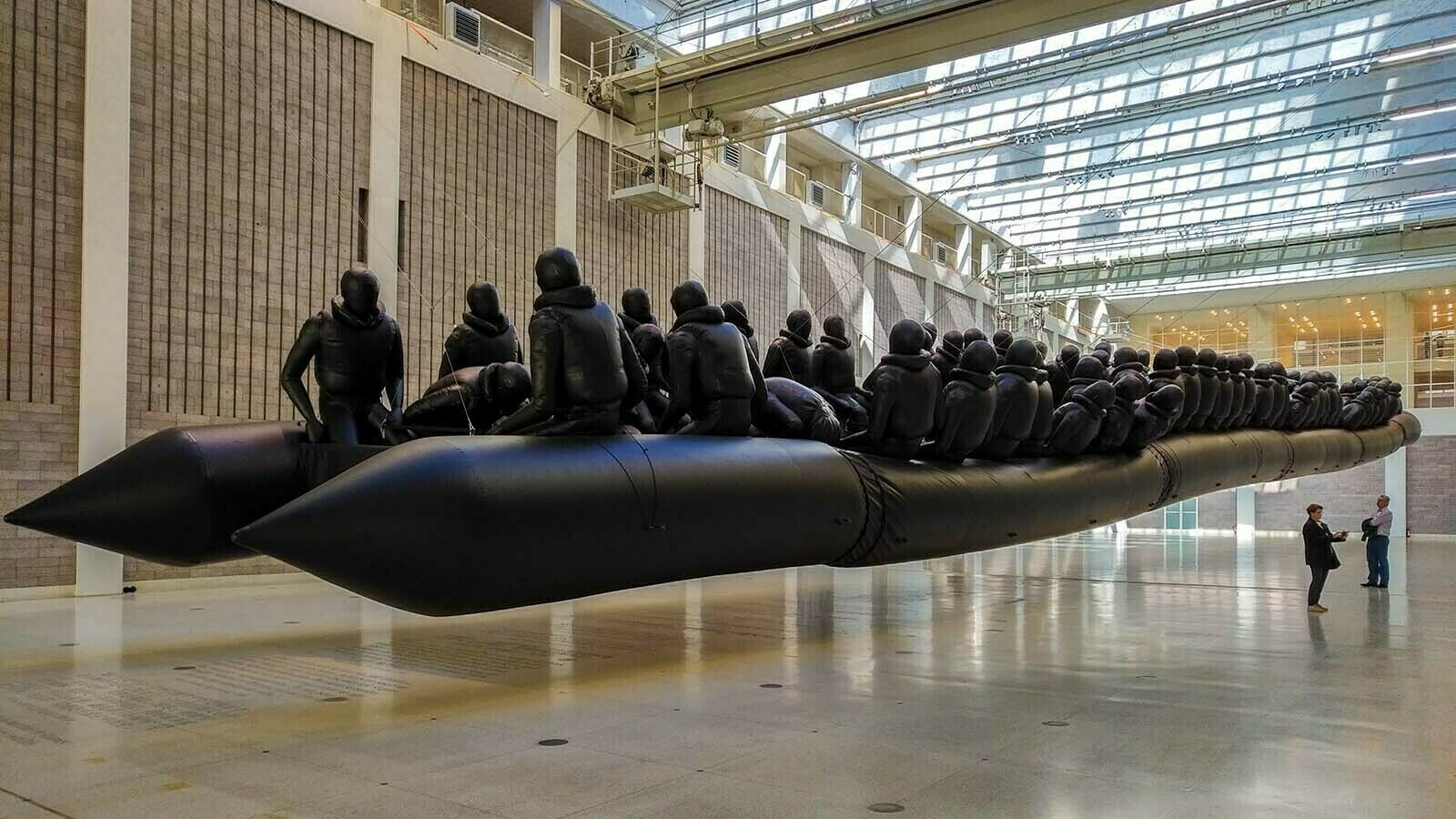
With such a title, De León (now at UCLA) and his collaborators were building on long-standing legal and historical concepts: The notion of a state of exception has been around for a long time, at least since the early 1920s, when the infamous Nazi jurist and legal theorist Carl Schmitt thematized the sovereign-serving suspension of the rule of law. But, as De León and his collaborators show, states of exception do not always entail marquee suspensions of norms or laws, the sort of which Schmitt was writing. At a similar intersection of migration and law, Chinese artist Ai Weiwei created Law of the Journey (2016), which showcased an enormous inflatable raft packed with faceless figures suspended high in its gallery, for emphasis and for examination.
These contemporary artists underscore how migrants and refugees continue to inhabit gray zones every day and everywhere, highlighting both the micro-materiality and the macro-stakes of abstract legal notions. These pieces manifest how such states of exception are written, often brutally, on the body in both life and death on a shocking scale—how they are sustained in sundry and disquieting forms, abiding in our culture even as they spread.
One could ask: didn’t we discuss this in the 2000s? Indeed, but these lessons seem un-learned and under-explored, per the work of De León/Krugliak/Barnes and Ai Weiwei. What is old is new again, such that the questions begged concern not of their existence, but of the contemporary conceptualization of such states of emergency, exception, and emergence after them. Apropos the French expression plus ça change and these epistemological questions, in the film classic La Haine (Hate, 1995)—about Paris and its suburbs in the wake of anti-police riots—the main characters discuss such questions of the normal vs. the exceptional with an idiom: They imagine a person falling from a high building and saying, as they continue to hurtle toward the ground, “so far, so good!” This cultural expression parallels, of course, English’s “frog boiling”—with the hapless amphibian unaware of what is unfolding in the water around it. The differences between the expressions are, however, telling, a kind of cross-cultural parallax view: In French, the expression emphasizes people, their built environments, and the world, in general, around them. Indeed, for the main characters-friends of Hate—one African-French, one Jewish-French, one Arab-French—this image of an optimistic person falling highlights a delusion of calm in exceptional circumstances. In the film, that image scales up to a society in denial, simultaneously plummeting and telling itself things are fine.
It is in the space between theory and image that both artists and scholars can concretize the abstract, the fleeting, and the elusive, to render them comprehensible, to make them memorable—above all, to build to an understanding of how these spaces and times, here of atrophied norms, suspended laws, and wanton impunity, can increasingly predominate in a society, if left unchecked. De León inspired the State/Estado exhibition with a research project, and many of its objects are neatly encased in tidy plastic bags, linking the scholarly archival to the creatively artistic. These questions are not merely historical or archaeological: One could and probably should add to them the breakdown of the “rule-based order” among community and non-state actors. The wobbly rule of law, radical technological transformation, unabated climate transformation, and global military expansionism are all pushing and being pushed into unknown exceptional territory.
When Schmitt developed the notion of a state of exception, he was apotheosizing the (fantasized) sovereign, whom he saw as ruling on the boundaries of normal and exceptional and subsequently exercising greater “decisionism” in moments of the latter. But these works bring to our attention how the rule and predictability of law are suspended all the time and all over the place. The antifascist critic and theorist Walter Benjamin developed Schmitt’s notion in a radical rethinking, as Giorgio Agamben has argued: Benjamin points out in his “Theses on the Philosophy of History” (written as a refugee from the Nazis, shortly before his death during his flight) that these states of alleged exception had, in fact, become the rule, the normal, expanding in both space and time. Since that work, the understanding of expansive states of exception—in time, space, and the body—has grown: various theorists, like Achille Mbembe, have argued that, for centuries, colonialism operated in this legally liminal zone of unbridled violence and endless avarice, a self-serving state of exception akin to faraway forever wars waged against the ethnically and ideologically different.
This conceptual constellation raises questions of precedents and traditions, of comprehending the present moment as well as of imagining any kind of future. “Exception” highlights a break from a presumed regular or normal order—persisting practices with which there is some break—while “emergence” points to what can, and will, be made of it.
States of Exception, States of Emergence will be the focus of UCHRI and its collaboration with the UC Humanities Network, guiding events, programming, and UCHRI’s regranting. We invite proposals that address the following questions and projects:
- How are/were states of exception created by individuals and their communities and to what ends? Under what conditions and with what means? What do/did they, ultimately, alter, suspend, and deliver?
- Given these historical and contemporary forms, how are we to recognize such states and to act with or against them? How are our actions to be recognized, conceptualized, and strategized?
- What is/was the presumed “normal” order of things against which these states create (and take) exception? How do they activate an emergency that disrupts the normal and tends to the exception?
- What are the post- or nonhuman aspects of these exceptions in an age of ongoing and fundamental climate and technological transformations? What emergent futures might they suffer or enjoy?
- When do/did military actions, with their constant “collateral damage,” become, or not, legally-defined atrocities, crimes against humanity, and genocide? What is the status of the relevant and reliable evidence in exceptional times?
- How, in the vein of the artworks above, are these states of exception or emergence to be documented, archived, and analyzed in our scholarly or creative work?
- In general, how can a sensitivity to these dynamics around states of exception and emergence change our scholarship?
UCHRI looks forward to exploring these and other issues with colleagues and students in the UC system in 2027-28. Explore our open calls and apply by January 19, 2027.
Events & Resources
UC Riverside |
Friday, March 7, 2027: States of Exception, States of Emergence: 2027 UC Graduate Student Virtual Conference — Proposals due by January 18, 2027. Interest form here.
Location: Zoom
UCHRI |
Thursday, October 22, 2026, 5:00-6:00pm PT: The USA’s 250th Anniversary: A Conversation with Eddie Glaude Jr. (Princeton University)
Location: Zoom
Thursday, November 12 (5:00pm PT) and Friday, November 13, 2026 (9:00-5:00pm PT): Generative AI and the Future of Judgment
Location: UC Irvine campus and Zoom
Thursday, January 14, 2026: 5:00-6:00pm PT: “Muskism and Our Historical Moment” with Prof. Quinn Slobodian (Boston University)
Location: Zoom
Thursday, April 22, 5:00-6:00pm PT: “Call It Evil: Understanding the Trump Era” with Prof. Susan Nieman (Einstein Forum)
Location: Zoom